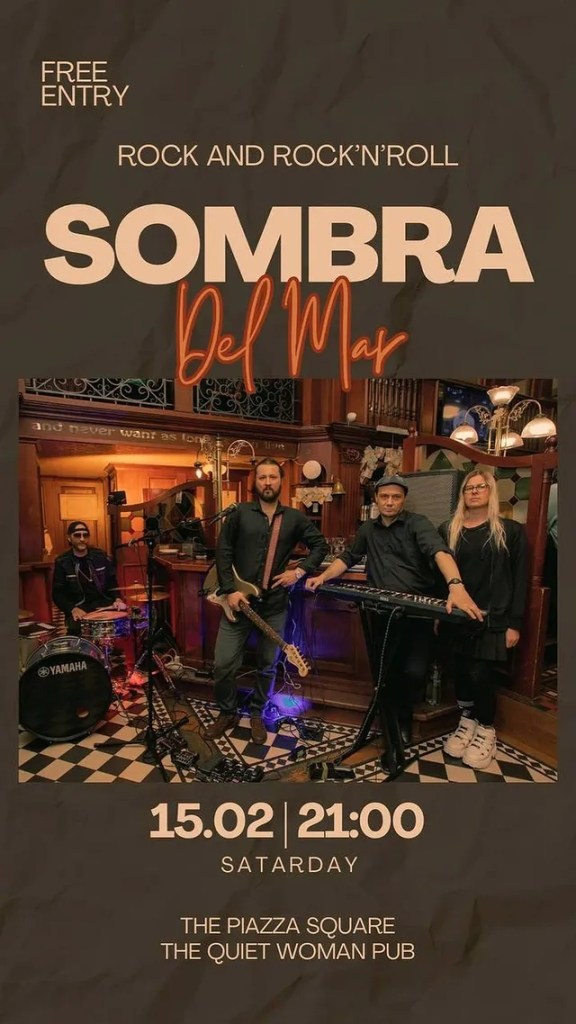
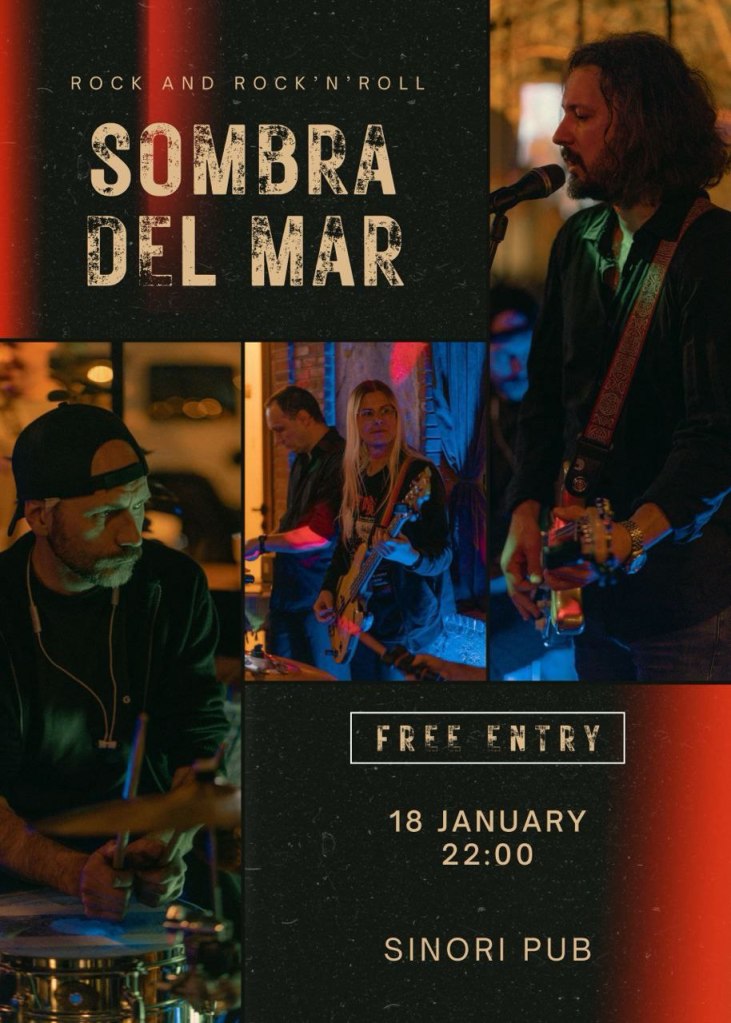
A quartet of expats from Russia and Belarus. Seen a thing or two in our lives, some even more than they ever wanted to. Nowadays we’re playing music that is in high demand, and surprisingly those are rock’n’rolls above all things.
Frankly I’m no big fan of the old rock’n’roll when it comes to listening, but playing them is an entirely different thing. A cool one, in fact.
Static Apparitions – a new release of my project ‘black-sided sun’. Genre – dark ambient. Released by Neotantra label (a lot of gratitude goes to Lee Norris).
Released as free download.
Tomorrow I’ll launch a special version of this album on my own page.
The onslaught of AI upon the music field is staggering and terrifying. Over the last few days I’ve stumbled upon an incredible amount of the low-effort content on Youtube, covering some unexpected areas: there are AI-generated extreme metal ‘records’, AI-generated krautrock, and, of course, tons of AI-spawned ambient. These genres tend to be less formulaic, and relatively marginal, compared to pop music. Yes, probably there are tons of AI-spawned pop too, I just don’t want to dive into this mud. Problem is, there are no extant genres un-parasited upon. And it takes quite a lot of attention to the secondary details, to see that it is synthetic media, not a well-performed, mixed and mastered music by humans.
In some cases (I strongly suspect that only in some) there is a barely-noticeable ‘synthetic content’ warning in the description, whereas, in my views, it should be on the top and glaring like a neon sign.
Seriously, I’d love to see an option to filter this content out completely. But there is none.
AI is a threat. It is not just a new technology ‘to unleash creativity and productivity’. It’s not a printing machine, a stoking frame, or an agrimotor, nor this is a photo camera, or, God help me, a synthesizer or digital creation tools like DAWs and Photoshop. Those are, after all, ‘interfaces’. Occasionally they ended up replacing certain professions, but without actually making humans ‘an expendable ware’, Matrix-style.
At present it does look like AI arrives in order to to supplant creatives those are historically bad at being controlled. Off with them, then: they have more than enough ‘stuff’ created over the centuries so that obedient, simulacra-spewing mill never ceases production. And why not? – All music had been already composed, every possible story plot has been covered multiple times, there is more poetry in the world than any human can read throughout their entire life, every possible dramatic turn has been explored.
Besides, the general populace tends to hold everything pertaining to the modern arts in contempt, especially in the less free societies. Everything that is art already exists, the rest is not needed nor wanted. The AI’s products are okay within this thinking framework.
New technologies surely do affect the progress in arts. Always’ve done. Until the generative AI, that is.
It is not about leaving creatives penniless (since the emergence of Internet they aren’t exactly revelling in gold, anyway), or altering the ways of creating ‘content’. It is exactly where Spotify’s CEO Daniel Ek memorable quote ‘cost of creating content being close to zero’ starts ringing true.
AI comes to unmake the arts and creative work. And there doesn’t seem to be any emergency switch to stop that mad train before it rams the very foundations of civilization. Probably it is too late already.
A short but fierce hurricane cut our yesternight performance short as we started our third set. Played just one song – during which summer restaurants chairs started flying around.
‘Titanic vibes’, some people commented afterwards. Well, indeed. Especially when you’re on the stage that has been already crushed down by snow earlier this year.
Afterwards I’ve read that two people have been injured during the hurricane by a falling piece of loose roofcover, just a couple of walls from us. They’ve been hospitalized promptly, and will make a full recovery.
In fact, this year’s weather patterns are, to put it mildly, unusual: heavy snowfalls that brought a 100K city to a halt for days, then +30°C/86°F in March, then this.
And an earthquake? Ah, no, the last one happened back in November :)
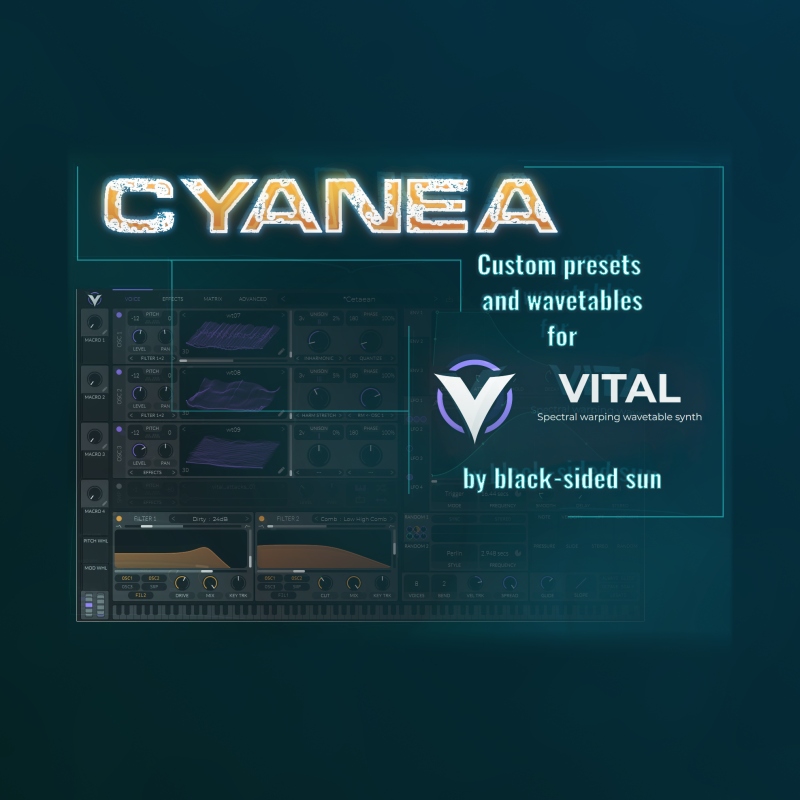
Cyanea is the bank for Vital I’ve been working on over the last few weeks. Vital is a mighty thing, although I’d love it to have some features of Surge XT. Just a wishful thinking, anyway.
The full version of Cyanea pack consists of 56 presets, with half of them being pads. There are also 108 custom made wavetables – Vital has a great wavetable editor and is capable of exporting them as .wav files.
There is also a free bank with 10 presets – exactly the ones I used to produce the demo video.
Both are available at Gumroad, along with other packs.
The initial idea was to set the sliders in the same positions and see what holds. But that just did not work.
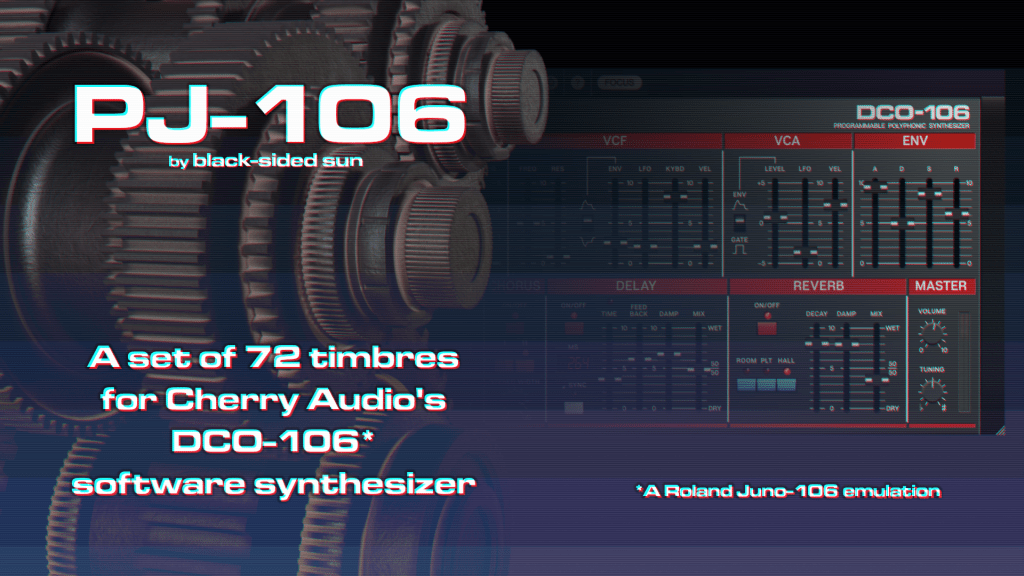
So the PJ-106 variants of preset were tweaked or re-dialled to sound more like patches from PJ-6.
It turned out way trickier that expected. Whereas Juno-60 and Juno-106 are reportedly rather similar, U-NO-LX and DCO-106 are drastically different from each other, preventing patches from sounding identical or even similar enough to each other.
For one, DCO-106 lacks U-NO-LX’s polyphonic unison mode, it has only a more traditional monophonic unison. Second, their envelopes seem to be working differently, and so do the LFO’s. Third, TAL’s plugin allows to fire up both Chorus effects at once, which is not possible with DCO-106.
DCO-106 is a great synth, but personally, if I’d have to choose between them two, I’d select U-NO-LX. Its sound clicks with me much more. Besides, it taxes CPU much less.
My attempts to translate the patches from TAL U-NO-LX to Cherry Audio’s DCO-106 proved to be way more problematic than I expected. These emulators may cover similar instruments (Roland Juno-60 and Juno-106, accordingly) but some of their aspects, such as LFO, inverted Envelope for the LP filter, Arpeggio settings, Unisono mode – they all are strikingly different. Filter itself behaves a bit differently too: in U-NO-LX it’s 0-to-1 scale (logarithmic?), in DCO-106 it’s frequencies. So the exact reproduction with mere setting the sliders at the same positions is out of question. I’m trying to make similar sounds, but it takes way more than I’ve bargained for. And I still love U-NO-LX’s sound more. Besides, Cherry Audio synths are more gluttonous about the CPU, which is a bit embarrassing.
I wonder if the approach with maxed-out resonance and noise oscillator will work in 106…
Back in 2020, during the COVID pandemic, I’ve completed one of the longest of my projects – an LP ‘Equinox: The Rite of Spring’. It tells about a catabasis-type journey through the night of Spring Equinox, i.e. March 20. A journey that followed a catastrophe.
It started out in 2011 with a very grim two-part dream about the sun disappearing, and how the city I’ve been living in back then kept going as though nothing actually happened.
I’ve expanded the story later, bringing in a brutal attack by fascist maniacs upon their former friends and neighbours, led by a ‘false philosopher’ (I stopped short of calling him by an actual name), a shameful escape and more…
Well, that was just a fiction. Until 2022. When just too many things described two years prior became reality. And even the circumstances of my eventual escape from Russia were chillingly similar to the song texts I’ve written.
Now I see how a similar disaster is unfolding in US…
Civilisation is damn fragile. It takes so much to get established and so little to get dismantled with dark ages following.
Our civilisation is at the worst threshold than ever over the last half a century at least. Probably at the worst since the end of WWII. The current strain of fascists have nukes, after all. And really want the world either to be reshaped according to their ill views based on the mix of fear, hatred, weaklings’ desire to be strong and punish everyone… Or to go down with it in flames.
The hope dies last. But it is possible that there is no room for it already. I wish I was wrong…
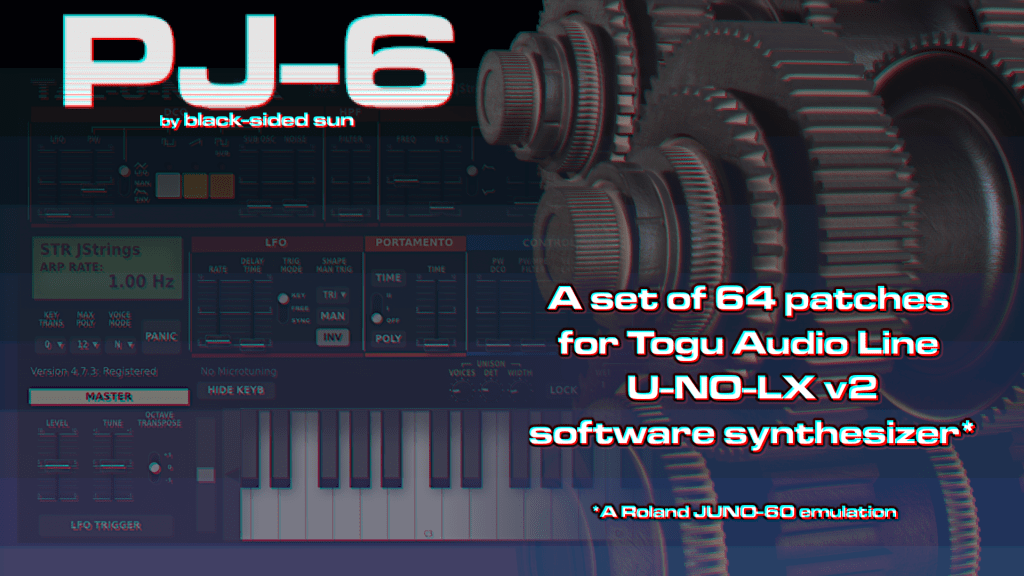
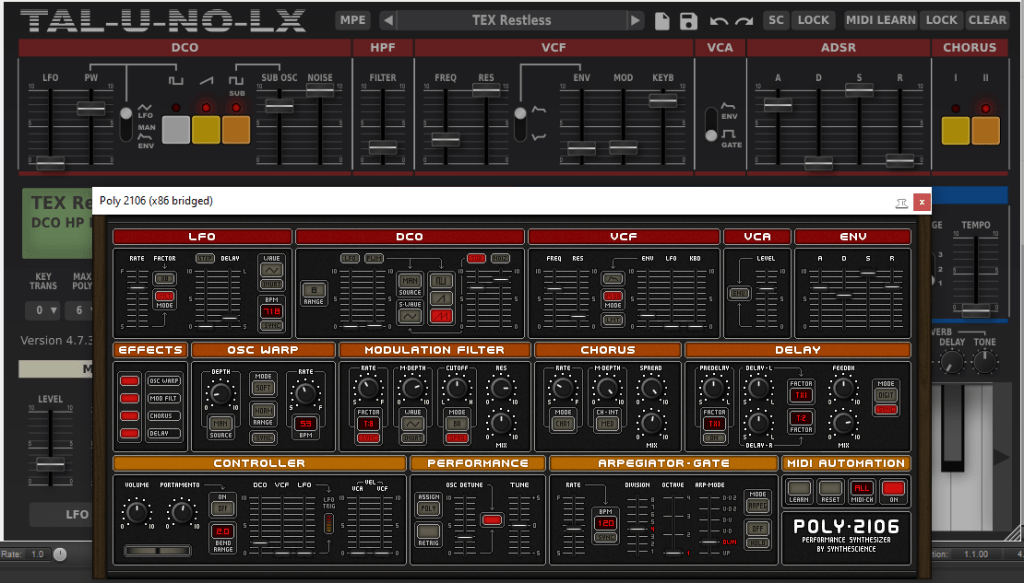
Just released PJ-6, a new soundpack for TAL U-NO-LX synth, which is an emulation of the classic Roland Juno-60 hardware synthesizer – beefed up to become a sonic powerhouse, despite its somewhat limited architecture.
I see now, how practical was the claim by Enya‘s producer Nicky Ryan that they will never get rid of Roland Juno 60. Dug deep into TAL’s emulator (U-No-LX) and can’t stop tinkering with it. Despite its deceptively simple architecture, the synth is a sonic powerhouse with totally enormous capabilities.
Surely it has some upgrades, such as Unisono mode and on-board effects, but it sounds great w/o them either: double-mode chorus does the job alright.
Ironically, years ago I’ve stumbled upon Poly 2106 freeware vst, that is obviously inspired by Roland Juno-106. It has got a few tremendously beautiful patches, yet in Reaper it also has some abysmal performance issues rendering it almost useless.
But I’ve finally managed to reproduce those sounds closely in U-No-LX (which is a commercial plugin), and it sorts out a problem or two for me, actually.
Making a custom pack for it U-No-LX, for the hell of it. The I’ll try to make their counterparts for Cherry Audio’s take on Juno-106 and, probably, old-but-gold u-he TyrellN6, which is also reportedly inspired by Juno 6/60/106 family.
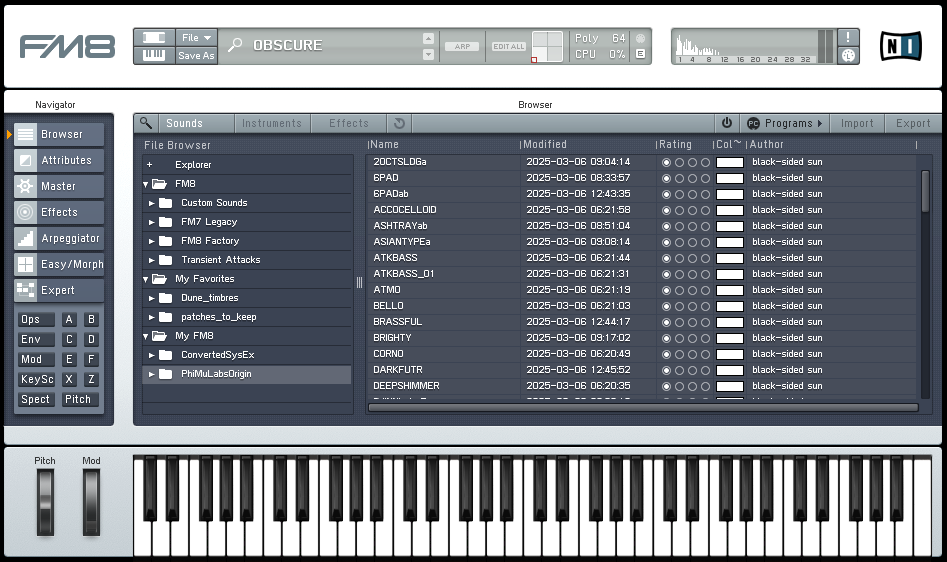
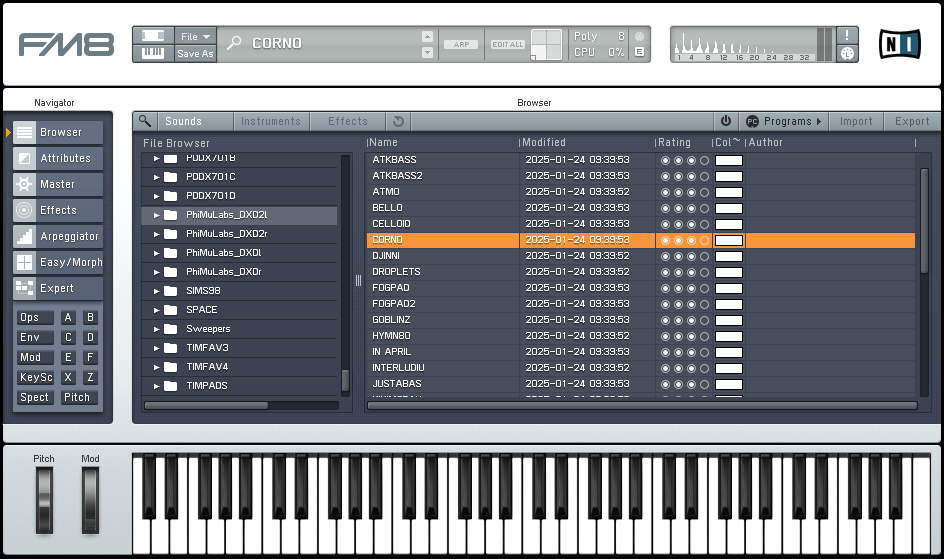
PHI MU LABS: ORIGIN is a collection of timbres created specifically for FM synthesizers. These patches have been also used to produce PHI MU LABS, vol. II library for KORG WAVESTATE and are included in that package as well. ORIGIN also includes the patches in Native Instruments FM8 format.
All patches had been dialed up from scratch in DEXED, a software emulation and librarian for Yamaha DX7.
Compatibles
The patches in SYSEX format are compatible with a number of hardware synthesizers, such as:
Limited compatibility with the four-operator FM synthesizers is expected as well.
Yamaha DX7, DXIID, DX1 and DX5
DX7 in its original form (Mk1) was essentially a 16-voice monotimbral synth with a mono output only. Its relatively low price and sonic capabilities made it one of the most popular and successful synthesizers of 1980s, and one of the definitive instruments of the era.
Less known are DX1/DX5, the flagship models those essentially sandwiched two DX7s under the same hood. Patches for DX1 and DX5 comprised the pairs of DX7 timbres, slightly altered realtive of each other for stereo effect.
This approach is implemented in PHI MU LABS: ORIGIN banks as well: two banks – PhiMuLabs_DXDl.syx and PhiMuLabs_DXD2l.syx are for the left channel, and two others PhiMuLabs_DXDr.syx and PhiMuLabs_DXD2r.syx – for the right one. The versions marked with ‘r’ are the tweaked versions of ‘l’ patches with the same architecture. Only some parameters are altered.
In software, one can fire up two DEXED instances (or any other software emulation) in the DAW, assign them to left and right channels, and load the specified pairs of patches.
DX7II is expected to support loading these SYSEX files either.
Native Instruments FM8
FM8 still looks like The Ruling Emperor of the FM world. Whereas its progenitor FM7 was more like a DX7 emulation with bells and whistles added FM8 takes this type of synthesis to the whole new level.
First and foremost it gets rid of one of the most serious limitations – the algorithms. These are the fixed combinations of sine wave generators (known as Operators in FM synthesis world), implemented with the original hardware instruments largely due to the limited capabilities of then-contemporary hardware. Yamaha DX7 originally featured just 32 algorithms to choose from.
FM8 instead offers a matrix the enables modulating anything with anything. Moreover, it allows to load up to four different patches and, well, mash them up.
It still supports loading SYSEX from DX7 and other compatibles, however.
All the PHI MU LABS: ORIGIN sysex patches had been converted to FM8’s own format. In most cases the patches’ architecture remained intact, with only minor tweaks such as adding effects and increasing the volume.
There is still a lot of room to further transform these timbres into something very different.
Have my hands full with rehearsals and gigs – we’ve got some kind of a residentship with a local venue, which is an Irish Pub. The only problem for me is that it’s located on the other end of the city from our appartment, heh. On the other hand, walking just under 3 miles one way then back again can’t hurt, and the weight I carry isn’t that large.
Other than that I’m finishing yet another library – for FM synths this time, and trying to do some extreme metal thing, evoking 1990s feel. For that I rely heavily on Korg M1 (even though in its VST form). A lot of the metal and gothic bands from those days apparently used its sounds religiously: Paradise Lost, Sanguis et Cinis, Diary of Dreams, many others. Some M1 timbres that don’t feel like anything natural on their own, really do the job in the mix.
The problem for me is with the guitars. I’m a $*itty guitar player, and will probably have to hire someone capable of doing guitar solos and more technical riffage.
Ah, and I don’t have a real bass guitar now (it stays with my daughter back in Russia), so have to emulate it with keys. Guitar drive/distortion/fuzz effects are software either (but not the guitar itself). Hopefully it doesn’t make the whole thing ‘fake’.
Finalized a track yesternight, did some rough mixing-up earlier today. The electric guitar parts are real: awfully recorded four layers. I’m getting somewhat better with guitar tremolo, but it’s way too far from ideal.
Quite unfortunately I’ve been hit with nasty flu, so I’ll have to perform wearing a medical mask this time. Not an enjoyable experience.
Elsewhere, it is utterly enjoyable to see how many people come to download Luminophore pack. And it looks like it’s not only about being free – a few have actually tipped me for it.
Recently looked into my – quite multiple – bandcamp accounts and discovered that the very first album by my first band had been released around this time back in 2007. 18 years ago.
I was 18 years old myself when this project – Lacklustre Mirror – started out. Had zero comprehension how things are done back then, except for composing music which I did since early childhood.
The first album – The Book Of The Shattered Bonds – when it finally has become a reality, with a factory-pressed physical CD in my hands… Well, that was both my victory. And an utter defeat too.
I feel no shame for the music composed for it. But I’m also pretty much aware that my English back then was abysmal – I still cannot get rid of that Eastern European accent; the lyrics were poorly written and ripe with errors, grammar-wise. Vocally I was not trained well enough yet. Massive screw-ups with arrangements are there too.
And the overall sound… Truth is, the sound engineer we have been recording this LP with, had never worked with any kind of this music before, and I had tough time explaining to him what I wanted, and why this blasphemous amount of reverberation was a must.
The album felt like an icy-cold dream on the verge of a nightmare, and making it proved tough and painful so much that I felt zero joy when it was out eventually.
The label failed (and was never too eager) to sell the entire stock. And as far as I can say, the only song that got some exposure, was ‘Dark Water’.
The primary mistake was trying to play some kind of a progressive rock and consider it to be anywhere related to gothic music. Although mr. Mick Mercer praised this LP (and even more praised its follow-up).
Just listened to it. Really don’t want to find myself again in the same emotional space I’d been to when composing and arranging all of this. Even though the times are even darker now.
I’m forever grateful to those who helped me to make it, however, and in particular Celestial @Ir and Marea Internum. And I’m really sorry for being occasionally less than a decent person with them.
…Last night I walked back home after a very good gig. Really a good one. The night was relatively warm – especially for the mid-Winter, skies clear, stars and planet shone bright…
But my brain was wormed with a grim thought: what if everything was basically pointless? What if every technology we take for granted today will become a weird and incomprehensible sorcery for our rags-clad descendants in a generation or two? – those, who survive the upheaval which is to come?.. Was there any point in all those efforts, composing and recording the dark and sad music – or any other kind?..
Earlier today have uploaded a free pack for Surge XT synth to Gumroad (as freeware). And within hours got 5 downloads, with sixth extra – someone picked another freeware pack I’ve made for WhispAir previously.
Looks like at least some interest is there. I guess, I know which synth I’ll be making patches for next. Probably for sale this time.
How often do we all, me and you, Bemoan our life’s misery! Oh, if only you, my friends, could know The chill and darkness of the coming days!
Now, you cuddle your dear’s hand, Play with it joyfully, Then cry, once you notice lies, Or discover this hand holds the knife, Oh, dear child.
There are no limits to lies and guile, Whilst Death is far away. Darker and darker will be terrifying light, And the maelstrom of planets will grow more and more twisted For centuries, centuries!
And the Last Age, the most terrifying of them all Shall we see – me and you. The skies will be consumed by the heinous sin, All laughter will freeze – [into] the yearning of non-existence.
My child, you will be waiting for the Spring And the Spring shall deceive you. You will call the Sun to the skies, And the Sun won’t be rising, And the cry when you start screaming, Will silently fall down like a stone…
So be content with your lives, Meek and mild ones. If only you could know, children, The chill and darkness of the coming days…
Code Zero-One is the free bank, which also contains custom wavetables created with AUDIOTERM software. They can be used separately.
The winner of the KVR Audio Developer Challenge 2021, WHISPAIR is a 3-osc wavetable synthesizer with significant modulation capabilities, written in native C++ code for high performance and low CPU consumption. It is offered as a software instrument for Microsoft Windows (VST2/VST3/CLAP/AAX) and Apple macOS (VST2/VST3/CLAP/AU/AAX). The synth’s creator himself used AUDIOTERM to produce a multitude of wavetables for WHISPAIR. The instrument’s rich default menu of wavetables can be expanded further with custom WAV files.
Hear the demo below. Except for drums, all sounds come from WHISPAIR. Drums programmed using Full Bucket’s another emulator – DRUMTRAQS.
Later I’ll upload yet another bank – for Surge XT this time. It is free either.
The months-long work is done: Phi Mu Labs, vol. II – the FM-synthesis based sound library for Korg WAVESTATE synthesizer has been completed and published at Gumroad along with the first one.
And here goes the video demo of several performances created with those multisamples I’ve been rendering and looping over all that time:
In 1983 YAMAHA Corp. released DX7, the first successful digital synthesizer and is one of the best-selling electronic instruments in history, selling more than 200,000 units.
DX7 and its derivative models utilized the Frequency Modulation sound generation technology developed by John Chowning at Stanford University and previously deployed, although with little commercial success, by Don Buchla.
With its bright, metallic and glassy sounds, DX7 and the subsequent models of the series, have largely shaped the sound of pop and rock music of 1980s.
Subsequently YAMAHA introduced SY series of series those combined FM and AWM (sample-based) synthesis, enhanced with so-called Vector synthesis initially developed by Sequential Circuits. Vector synthesis provides movement in a sound by providing dynamic cross-fading between (usually) four sound sources. By bringing two ‘worlds’ together, SY-series synths enabled unique, moving timbres and sound textures.
The best known vector-based syntesizer so far, however, is KORG WAVESTATION presented in 1990. It has also introduced the synthesis method called ‘wave sequencing’, built on the earlier Wavetable synthesis technique. The wave sequence is a programmed list of PCM waves playing in succession, with each step having possibly different duration, pitch, fine tuning, level and crossfade amount.
It was WAVESTATION which had also introduced Wave Sequencing, a method of multi-timbral sound generation in which different digital (PCM) waveform data are played successively, resulting in continuously evolving sounds. It was a concept very similar to Wavetable synthesis, except that Wavetable utilizes single-cycle waveforms, taken from a specific part of a sample, while wave sequencing allows to play the whole sample.
With the joystick the variability of WAVESTATION’s sounds clearly poked the sky. Besides it has had numerous rhythmic presets compensating for the lack of on-board sequencer.
The coupling of Vector and Wave Sequencing synthesis methods essentially made WAVESTATION The Soundtrack Machine, and The Pad Monster shaping the sound and atmosphere of many mainstream and underground records throughout 1990s and later.
With Stanford University patent expiring, instruments from other vendors, hardware and software, started popping up. KORG have released a number of their own, both in 1980s (utilizing YAMAHA’s chip, though) and in 2010s – 2020s. There are multiple software emulations of YAMAHA DX7, such as freeware DEXED, commercial PLOGUE CHIPSYNTH OPS7, ARTURIA DX7 V, etc.
Some of virtual FM synths, like NATIVE INSTRUMENTS FM8, made a mighty leap forward compared to DX7 and later synths: even though it basically stuck to 6-op paradigm of Yamaha’s classic device, there are no fixed algorithms and thusly no limits to how operators can modulate each others.
FM synthesis remains somewhat enigmatic. It’s rather easy to understand the basics: mentioned above, there are Operators acting as Carriers and Modulators of the waveform. Then there are Algorithms – the fixed (usually) chains of operators linked together, and modulating each other. But how to get anything meaningful of them? And what does it heave with Harmonics? Translating the theory into practical use is a different stuff.
Fortunately there are tons of the information available on the matter now, including such precious works as ‘FM Synthesis of Real Instruments‘ (PDF), which largely demystify the FM alchemy. The author simply states that FM synthesis is ‘vibrato on steroids’. And it appears absolutely true once you delve into this synthesis.
Likely though the FM beginner would still go through a lot of trial-and-error before succeeding at creating their Epic Masterpiece Timbre (Hallelujah!). But you know what? With the current generation of software and hardware synthesizers, even ‘blind’ experimenting occasionally delivers.
In 2020 KORG brings back Wave Sequencing/Vector Synthesis combo in the form of WAVESTATE, a new instrument paying a very decent homage to Wavestation. However, unlike its predecessor WAVESTATE now is capable of reading and sequencing user-produced samples, which makes it a perfect playground for sound designers, while it’s factory sound library is terrific on its own.
Last year I’ve assembled a sizeable collection of FM-based timbres – i.e. sounds from FM synths sampled and, in most cases, looped for KORG WAVESTATE: Phi Mu Labs, vol. 1. It pays a homage to DX and SY synths ranges, showcasing how capable and timeless the combinations of various sound synthesis techniques are:
Yesterday I completed the second PHI MU LABS library, and right now finish a Youtube demo. As soon as it is done, the library will be available on Gumroad.
The latest gig was kinda alright, although the venue left a very unpleasant impression due to an abundancy of trashed barflies who appeared to be dying to put on some cheap-sounding muzak right after our performance. One of them – a particularly drunk and probably stoned – slammed us loudly for the refusal of playing something he tried to order. Well, ’tis just another occupational hazard. I was pretty much prepared for this kid going aggressive, but fortunately he didn’t.
No word yet when are we playing next time, but it won’t take long, hopefully.
Other than that, around this time 20 years ago I’ve wrapped recording my first dark-ambient solo album with the project ‘Decembered’.
It was born from the need to rebalance myself after the misery of previous years, and from a desire to find a more or less new way to make sounds. A new sources of sounds either :) So, everything was a go: badly detuned acoustic piano, a dog barking outside, some kitchen hardware which goes majestic under the layers of reverb.
Little did I expect that this kind of playground would last that long as Decembered did – 10 years, and 10 albums. Not all of them were exactly dark, and not all were about ambient alone, but in general… Well, I tried to alter my ways later with a more industrial-oriented project. Since it had been passed as something different that it actually was, I will not name it.
Eventually I turned back to dark ambient in 2022 with black-sided sun… just days before the war actually started.
Anyway, all the Decembered’s discography is available at Bandcamp. Give the first LP – ‘And That Was Just a Thaw’ – a spin tonight, preferrably in low light and, probably, with a glass of a good wine.
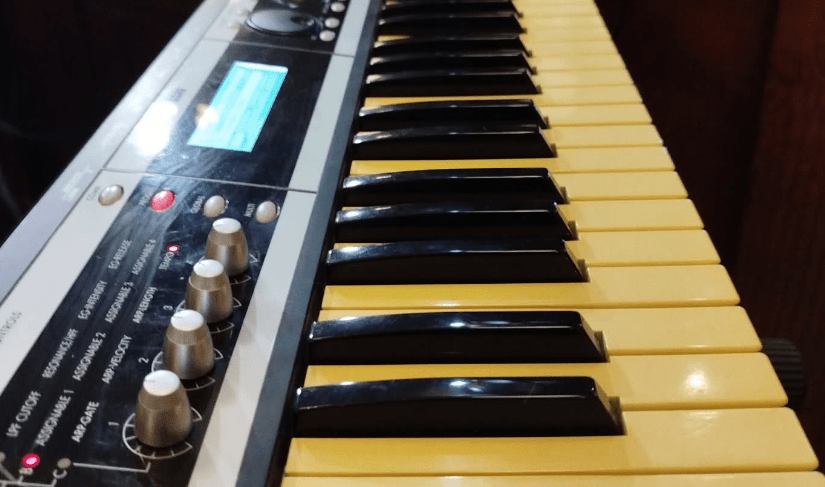
I’ve made a lot of mistakes in my life, but there are two things I think I did right: getting me a used Korg X50 and a new lightweight stand for gigging. Keyboardists often have to carry a lot of weight on them, especially when it comes to older instruments. I used to own Yamaha DX7. It weighted 31.2lbs/14.2 kg. Not quite the thing you’d love to carry, and particularly when you have to run to get into a soon-to-departure bus in mid-Winter.
Another of my keyboards was Korg 01/W FD. Its weight was 30.6 lbs/13.9 kg. That’s w/o bag, cords, sustain pedal, etc. Not exactly a gigging device either, although I occasionally played it.
I had a lighter alternative in the form of rack box Korg Wavestation SR, but my stupid mistake made a lightweight MIDI keyboard inoperable, so the box was largely out of equation.
And when I had to escape, I took no instruments with me.
Months later my wife, a saint, plain and simple, mailed me a bunch of my instruments ahead of joining me in Batumi herself. The package contained the lightweight Korg X50 keyboard and the keyboard stand, among many other things. In fact by that time I have constructed an ambient album with no musical keyboard whatsoever, but that is not quite the experience I’d like to repeat.
Over the last summer I worked for a short while with a young crooneress here. Ironically, the two level keyboard stand I’ve got me 15+ years ago, weighted almost as much as the keyboard itself. Quite intentionally I’ve bought a sturdy one back in a day, since it was supposed to hold two heavyweight devices when playing live (DX7 was one of them). But jogging around with it… not exactly a pleasure.
So I’ve picked a new stand, and it proved to be amazingly, amazingly lightweight (aluminium? no idea what else). Hopefully I won’t have to use it as a self-defense weapon, though :)
…The last gig was kinda alright, although there were quite a few screwups from each performer (with the exception of the drummer). The pub we played in has got no nothing even remotely reminiscent of the stage, so as we performed people walked around – and danced too. Unfortunately some pretty drunk guy dropped our singer’s microphone stand mid-song; he immediately placed it back upwards and apologized, but it’s always annoying when something like this happens. A professional hazard, on the other hand it is.
…If/when you do right, every gig is a celebration. At least it should look like the one for the audience. It’s nice if it feels like the one for the performers – a better rapport with the audience is invoked then.
But when it’s all through and you stroll home accross the entire city… All the problems you have set aside for these two or three hours roll back upon you with their crushing weight. Who cares, though.
Sombra Del Mar will next perform on Jan. 10, elsewhere. I’m yet to discover the place.