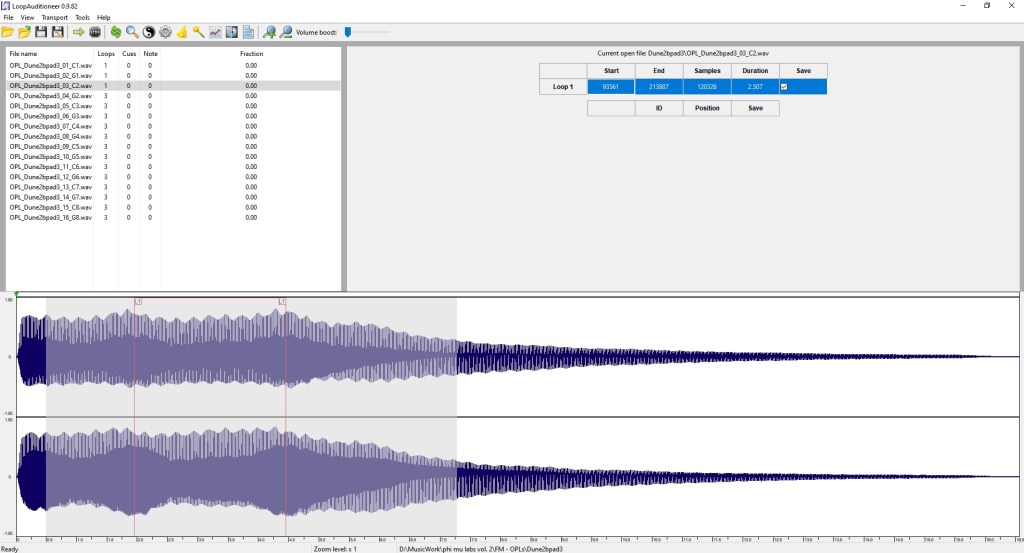
Going full steam ahead with making the second installment of my Phi Mu Labs – the FM-based timbres library for Korg wavestate. Cherry-picking or dialling up the timbres are fun, adapting them for the synth – much less so. Basically I render 14-16 .WAV files – two per octave (C and G notes). Some timbres are one-shot, some need to be looped. For the loop-making I use Loop Auditioneer, a free and opensource thing that allows to automate part of the job. But not entirely, and its loop-seeking routines don’t necessarily return good results. On the other hand, it allows to crossfade the loop candidate over the selected time period (up to 1000 ms), and that’s where the chore comes: sometimes you want to have as long crossfading as possible; but sometimes quite the opposite works best. Sometimes you may waste quite some time to get a single sample decently looped, because it just won’t get crossfaded smoothly enough.
The samples derived from the OPL2 emulators (JuceOPLVSTi and ADLPlug) prove to be very, err, resilient against the attempts to loop them properly in Loop Auditioneer due to their lo-fi nature. On the other hand, the loop ‘deficiencies’ would rather add to their wobbly grittiness.
For now the new library seems to be much more industrial-leaning than the first part, and will be possible smaller, raw sample content-wise. Then again, it is yet to be seen.
One really bad thing about Korg wavestate’s Sample Builder software is that it cuts off everything past the loop’s end. A lot of information gets wasted eventually. It would be nice is Loop Auditioneer allowed to cut the sample and discard all that isn’t needed. But, again, it’s a free software thing. It owes nothing to anyone.
 mirrorhe[art]