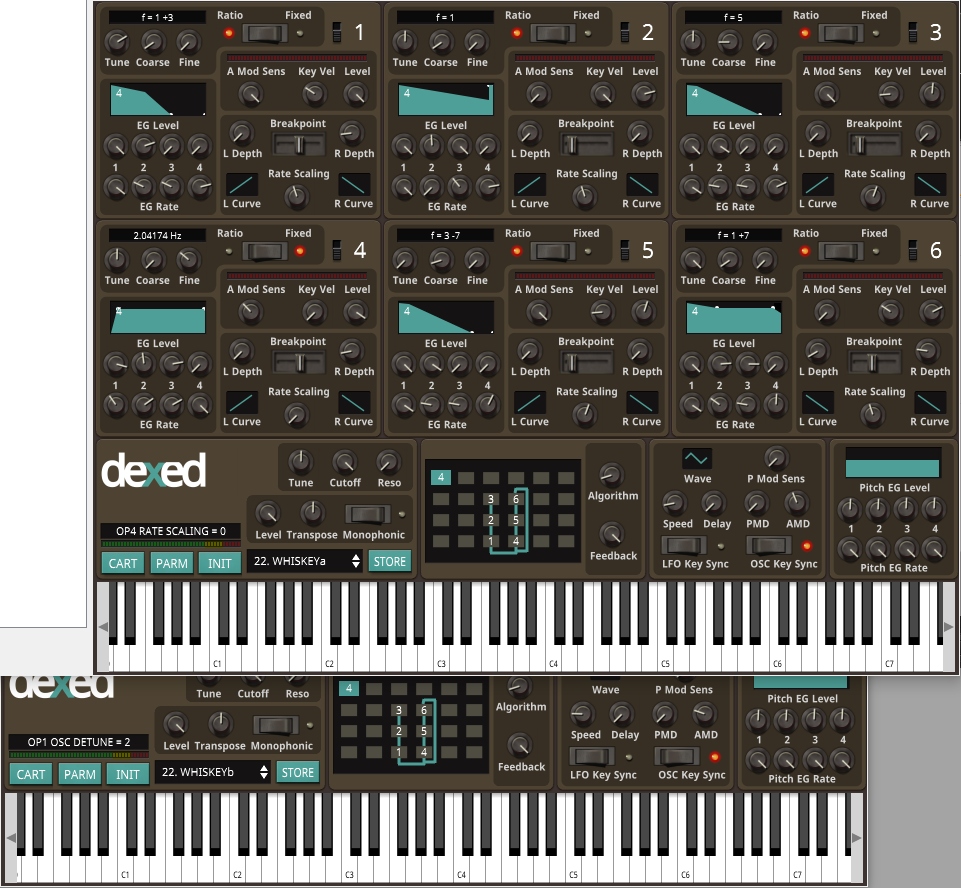
I’ve owned Yamaha DX7 for many years. Got it second-hand in a working, but cosmetically drastic condition. For a time being it was one of the keyboards I used religiously both on stage and in studio, considering it much more of an ‘honest’ synthesizer than any ROMplers I owned aside from that.
However, since discovering DEXED, I’ve gradually switched to it almost entirely: free, close to the original (at times better to my taste even), and doesn’t weight 14+ kg.
What I have never quite done before was trying to program a patch from scratch. In fact, there is some crazy amount of DX/TX-series patches presented in SYSEX format on the Web, and most of them are readable by DEXED.
There are just too much ready-to-go timbres to be used in your compositions.
Meanwhile, FM synthesis is a notoriously hard nut to crack on its own and, frankly, the way it had been implemented in DX7 wasn’t terrifically user-friendly.
DEXED streamlines the process a lot, however, it sticks with the original implementation of envelopes, and this alone takes a lot to get used to. Especially compared to other synths, even FM8.
In fact, after having fun with FM8 DEXED feels very rigid about routing: in FM8 you can route any Operator to any other, whereas Yamaha DX7 and DEXED offer only 32 algorithms, i.e. prewired combos of the operators.
Still, making patches for DEXED turned out damn addictive.
Just finished a dual pack of 32*2 timbres, set up so that it can be used on their own or in pairs for stereo effect. Fire up two instances of DEXED, pan them left and right, load up the patches with ‘a’ suffix to the left and those with ‘b’ to the right and here we go.
The demo will follow soon. I will add the samples produced with these timbres to the next part of Phi Mu Labs library, which, I think, will be ready by Xmas.
Stay tuned!
 mirrorhe[art]